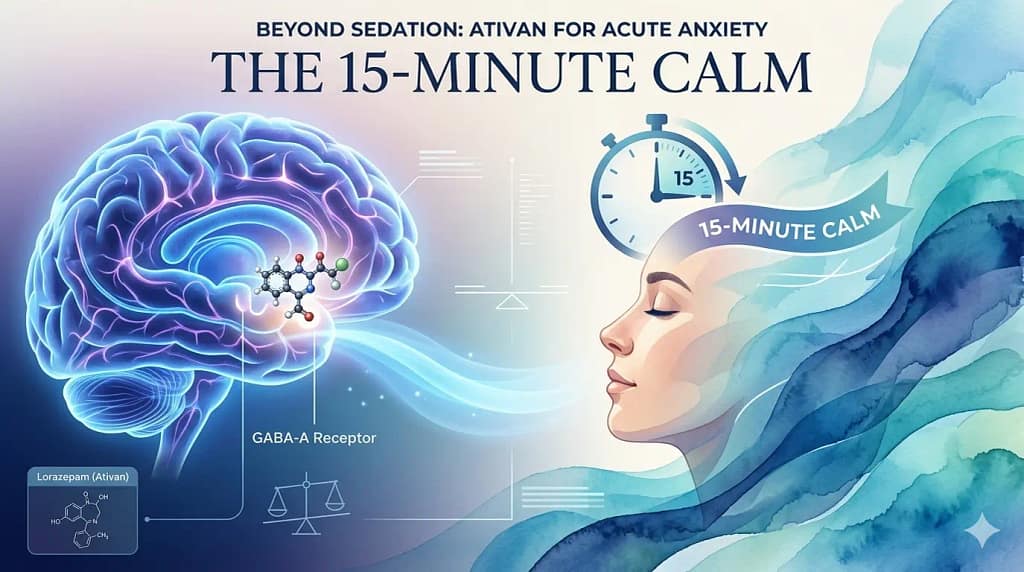
In the high-pressure landscape of 2026, where the pace of life and the prevalence of digital stressors have reached an all-time high, the clinical management of acute anxiety remains a critical priority for healthcare providers. Among the various pharmacological tools available, Ativan (lorazepam) continues to hold its position as the “Gold Standard” for the rapid interruption of panic attacks and severe agitation.
While newer, long-term treatments like SSRIs and digital therapeutics are vital for maintenance, they cannot match the “15-minute calm” that lorazepam provides during a physiological crisis. This review explores the pharmacokinetics, clinical utility, and the essential safety protocols governing Ativan use in 2026.
1. The Physiology of a Panic Attack: Why Speed Matters
A panic attack is not merely a psychological event; it is a full-body systemic surge. Within seconds, the amygdala triggers the “fight-or-flight” response, resulting in a flood of adrenaline, tachycardia (rapid heart rate), hyperventilation, and a profound sense of impending doom.
For a patient in the throes of such an episode, the brain’s natural inhibitory system—governed by the neurotransmitter GABA (Gamma-Aminobutyric Acid)—is effectively overwhelmed. This is where the speed of intervention becomes the primary clinical metric.
The 15-Minute Window
Ativan is classified as an intermediate-acting benzodiazepine, but its “onset of action” is what defines its utility. When taken sublingually (under the tongue) or even orally, lorazepam begins to cross the blood-brain barrier almost immediately, with noticeable physiological calming typically beginning within 15 to 30 minutes.
2. The Mechanism of Action: Restoring Neural Balance
In 2026, our understanding of the GABA-A receptor complex has become more refined. Ativan works as a positive allosteric modulator. It does not “create” calm on its own; instead, it binds to specific sites on the GABA receptor, making the receptor more sensitive to the body’s own natural GABA.
- Chloride Ion Influx: When Ativan binds, it allows chloride ions to flow more easily into the neuron.
- Hyperpolarization: This influx makes the neuron “negatively charged,” effectively raising the threshold required for the neuron to fire.
- The Result: The “electrical storm” of a panic attack is dampened, muscle tension is released, and the heart rate begins to stabilize. Ativan Half-Life
3. Why Ativan? Comparing the “Big Three” in 2026
Patients often ask why a physician might choose Ativan over other fast-acting benzodiazepines like Xanax (alprazolam) or Valium (diazepam). The answer lies in its metabolic profile.
| Medication | Onset Time | Half-Life | Primary Advantage |
| Xanax | Very Fast | Short | Extreme potency; high “peak” effect. |
| Ativan | Fast | Intermediate | Balanced duration; predictable metabolism. |
| Valium | Moderate | Very Long | Long-lasting; stays in the system for days. |
The “Liver-Friendly” Choice
One of the most significant reasons Ativan remains a preferred choice in 2026 is its conjugative metabolism. Unlike many other drugs that require complex oxidation by the liver’s P450 enzymes, Ativan undergoes simple glucuronidation. This makes it significantly safer for:
- Patients who age more than 70 years.
- Patients with compromised liver function.
- Individuals taking multiple medications where drug-drug interactions are a concern.
4. Clinical Applications in 2026
While panic disorder is the primary indication, the 2026 medical landscape utilizes Ativan in several specialized contexts:
A. Acute Situational Anxiety
For patients with specific phobias—such as fear of flying (aviphobia) or claustrophobia during an MRI scan—Ativan provides a predictable “shield” against the anticipated panic, allowing the medical or travel event to proceed safely.
B. Pre-Surgical Anxiolysis
Ativan is frequently used as a “pre-med” before anesthesia. Its ability to induce mild anterograde amnesia (preventing the formation of new memories during the procedure) is seen as a clinical benefit, reducing the psychological trauma associated with surgery.
C. Status Epilepticus
In critical care settings, intravenous Ativan is the primary clinical intervention used to rapidly terminate status epilepticus (prolonged seizures). Its rapid entry into the brain tissue makes it life-saving in neurological crises.
5. The 2026 Safety Protocol: Avoiding the “Benzo Trap”
Despite its benefits, the medical community in 2026 is more vigilant than ever regarding the risks of benzodiazepines. The “15-minute calm” can be seductive, leading to a risk of psychological and physiological dependency.
The “4-Week Rule”
Current clinical guidelines suggest that Ativan should be prescribed for short-term or intermittent use only. Continuous daily use exceeding four weeks significantly increases the risk of:
- Tolerance: A physiological adaptation where the brain’s receptors become less sensitive to the medication, requiring progressively higher doses to achieve the same therapeutic effect
- Withdrawal: Severe rebound anxiety, tremors, or in rare cases, seizures if stopped abruptly.
- Cognitive Blunting: Long-term use in 2026 has been linked to an increased risk of cognitive decline in older populations.
Medical Recommendation: Patients should be encouraged to use Ativan as a “rescue” medication—a safety net in their pocket—while simultaneously engaging in long-term solutions like Cognitive Behavioral Therapy (CBT) or non-habit-forming SSRIs.
6. Managing Side Effects and Interactions
As a digital marketing and pharmaceutical information provider, TrustPharma emphasizes that knowledge is the first step in safety. Common side effects of Ativan include:
- Drowsiness/Sedation: The most common effect, often described as a “brain fog.”
- Ataxia: A lack of muscle coordination; patients should not drive after taking Ativan.
- Respiratory Depression: This is rare at therapeutic doses but becomes lethal when combined with alcohol or opioids.
The 2026 Warning on “Poly-Pharmacy”
The most critical safety warning for Ativan in 2026 involves the concurrent use of CNS depressants. With the rise of synthetic opioids, the combination of a benzodiazepine and an opioid remains a leading cause of accidental overdose due to synergistic respiratory suppression.
7. The Future: Ativan in the Era of Precision Medicine
As we look toward the late 2020s, the use of Pharmacogenomic (PGx) Testing is becoming standard. By analysing a patient’s genetic markers, doctors can now predict with higher accuracy how a specific individual will react to Ativan. Some people are “ultra-rapid metabolizers,” meaning the 15-minute calm might only last 2 hours, while others may experience heavy sedation for a full day. Pregabalin vs. Gabapentin
At TrustPharma, we believe the future of anxiety management lies in this intersection of classic, reliable pharmacology and modern, personalized data.
Conclusion: A Tool, Not a Crutch
Ativan remains the gold standard for acute panic attacks because it does exactly what it promises: it stops the spiral. In the 15 minutes it takes to work, it provides the “biological breathing room” a patient needs to regain control.
However, the most successful patients are those who view Ativan online as a bridge to a more sustainable mental health strategy. By respecting the potency of this medication and adhering to 2026 safety guidelines, patients can utilize the “15-minute calm” to reclaim their lives from the grip of anxiety.